Deep Tissue Massage Bangkok
Deep tissue massage Bangkok works on the layers that lighter massage cannot reach. Slow, sustained pressure applied through the superficial muscle to the deeper fibers, tendons, and fascia breaks down adhesions, releases chronic knots, and restores normal tissue movement in areas that have tightened over time.
If oil or Thai massage leaves the same knots in place by the next morning, deep tissue is the correct tool. It resolves a specific physical problem rather than providing general relaxation.
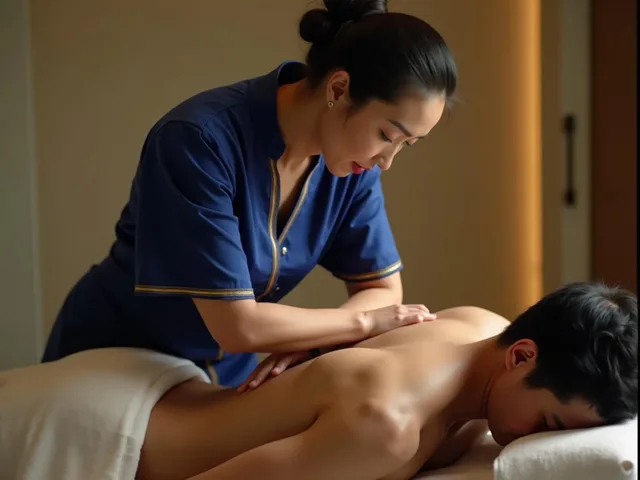
What Deep Tissue Massage Addresses
Three zones come up most often when guests book deep tissue massage in Bangkok:
- Upper back and rhomboids: Sustained laptop time or back to back meetings in Asoke, Silom, or Sathorn office towers builds mid back tension that lighter strokes barely affect. The trapezius and rhomboids hold chronic tightness that takes specific, prolonged pressure to release.
- Lumbar and glutes: Long haul flights from Europe or Australia compress the lower spine and cut circulation to the glutes. Passengers landing at Suvarnabhumi commonly carry dull lumbar pain that persists into the following day without treatment.
- Calves, IT band, and hip flexors: Runners at Lumphini Park, cyclists, and Muay Thai students training around Thonglor or Ratchathewi accumulate lower body load that responds well to focused deep work.
Neck and suboccipital muscles are a fourth common area, driven by screen time and forward head posture. Deep tissue at the base of the skull and across the upper traps requires slow, careful pressure, not aggressive force. Guests dealing with chronic back pain or stubborn muscle pain usually book 90 minutes so each zone gets enough time to release.
Who This Service Is Best For
- Long haul travelers: Flying economy from London, Sydney, or Tokyo and landing with a locked lower back. Deep tissue on the lumbar, glutes, and calves restores normal function faster than rest alone.
- Gym goers and athletes in recovery: Training at Sukhumvit gyms or Muay Thai camps and carrying tension in the posterior chain, legs, or shoulders from the previous session.
- Desk workers with persistent tension: Upper back and neck tightness that returns to the same spot after every lighter massage.
- Anyone who finds light pressure ineffective: If you leave an oil or Thai massage feeling better for a few hours but unchanged by the next morning, your body needs deeper work.
Bangkok Deep Tissue Massage Therapists Available Now




View all available therapists on our available now page.
Deep Tissue vs Traditional Thai Massage
Traditional Thai massage works without oil, using palm pressure, elbows, and passive stretches applied along the full length of the body. It resets general mobility and flexibility. Good choice if you want to feel less stiff after a long day walking around Chatuchak, the riverside temples, or Siam. The emphasis is full body, not targeted.
Deep tissue uses oil and holds pressure on specific, identified problem areas. The therapist works slowly, holding on each zone until the tissue releases before moving on. Choose it when you can point at an area that hurts or restricts you, not when you want general relaxation.
How Deep Tissue Massage Works
A muscle knot is a patch of muscle fiber that stays contracted after the work that caused it has ended. Blood moves poorly through the contracted patch, so waste products sit in the tissue and the area keeps aching. Rubbing the surface does not reach it.
Deep tissue works by holding slow pressure on that patch until it releases. The hold does two things at once. It brings fresh blood into the tissue, and it gives your nervous system time to accept the pressure and let the muscle go. Press fast and the muscle guards against you. Press slow and it lets go. That is why a good deep tissue therapist looks unhurried even while working at full depth.
One session gives real relief. Tension that took months at a desk to build usually needs two or three sessions, spaced across a week or two, before it stays gone. Expect honest progress, not a one time cure.
Firm Pressure Should Not Mean Pain
Good deep work sits at the edge of strong sensation you can still breathe through. Therapists call it a good hurt: focused, intense, and easing while the pressure holds. Sharp pain, numbness, or tingling is the wrong kind. It means the muscle is guarding or a nerve is involved, and more force makes it worse, not better.
Your therapist checks pressure with you at the start and watches your breathing throughout. You do not need special words. Say softer or stronger at any point and the pressure changes on the spot. Guests who stay quiet through real pain get less from the session, because a guarding muscle never releases.
What to Expect During the Session
Your therapist sets up in your room. Most sessions are done on the bed, and most Bangkok hotel rooms have enough space without rearranging furniture. Before starting, you will be asked where the tension is, whether any injuries exist, and how firm you want the pressure. Deep work on an inflamed or injured area causes harm rather than relief, so the intake is taken seriously.
The session opens with lighter strokes to warm the muscle and bring circulation to the surface. As the tissue softens, the therapist moves to targeted deep work on the areas you identified. Pressure is slow and held, not fast and sliding. You can ask for more or less at any point. The session closes with lighter strokes to flush metabolic waste from the worked tissue.
The day after a deep tissue session you may feel tender in the worked areas. This is normal and passes within 48 hours. If tenderness lasts longer, the pressure exceeded your current tissue tolerance. Mention it when you book next time.
After Your Session
Drink water and keep the rest of the day light. Worked muscle recovers faster with gentle movement, so a short walk helps more than lying still. A warm shower before bed keeps the released areas loose overnight.
Skip hard training on the worked muscle groups for 24 hours so the tissue can settle. For chronic tension, book one session per week for two or three weeks, then one every two to four weeks to stop the pattern from rebuilding. A single 90 minute session covers one time relief after a flight or a heavy training block.
When to Book Deep Tissue
- Post flight: A 90-minute session targeting the lumbar, glutes, and calves is one of the fastest ways to feel physically normal after a long intercontinental flight. Book same day on arrival or the following morning.
- Post training: Wait 24 hours after heavy training before booking deep tissue on the same muscle groups. Pressing deeply into already inflamed tissue increases soreness rather than reducing it. A lighter oil massage works better the same day. Return for deep tissue the following morning.
- Post desk: No timing restriction. Book whenever upper back or neck tension starts affecting sleep or concentration.
Deep Tissue Massage Bangkok: Duration and Price
| Option | Duration | Price |
|---|---|---|
| Deep Tissue Massage | 60 min | 1,200 THB |
| Deep Tissue Massage | 90 min | 1,800 THB |
| Deep Tissue Massage | 120 min | 2,200 THB |
The 90-minute session works best for most clients. Deep tissue requires 15-20 minutes of warming before the therapist can apply effective depth, leaving roughly 40 minutes of productive work in a 60-minute session. At 90 minutes you get the full warming phase plus 60-70 minutes on your target areas, which is enough to properly address two or three problem zones. The 120-minute option covers the full body or two focus areas on opposite ends.
Booking Deep Tissue Massage in Bangkok From Your Hotel
Send your hotel name, preferred session length, and which areas need attention. We confirm the therapist, price, and arrival time before you commit. Central Bangkok, including Sukhumvit, Silom, Sathorn, Phrom Phong, Thonglor, and Riverside, sees 20-40 minute arrival under normal conditions.
For full Bangkok area coverage and pricing, see Outcall Massage Bangkok. For hotel specific details on lobby access and visitor procedures, see Hotel Room Massage Bangkok.